Guide
Google Cloud Committed Use Discount Optimization
Committed use discounts can cut your Google Cloud compute bill substantially — but only if you commit to the right amount, for the right term. Most tools size that commitment from your usage history and hedge the rest. This guide takes the other path: how to plan CUDs around the demand you already know — signed contracts, a funded migration, a steady baseline — and how Solvicus computes the cost-optimal plan for it.
What is a Committed Use Discount?
On Google Cloud, you can run compute at the on-demand rate, or you can buy a Committed Use Discount (CUD): you commit to a level of resource usage — vCPUs and RAM — for a fixed term of one or three years, and Google charges you a substantially lower rate in return. The longer the commitment, the deeper the discount.
Resource-based CUDs commit spend on vCPUs and RAM within a machine family and region. That makes them powerful, but it also makes the buying decision a real optimization problem rather than a checkbox: every unit you commit is money you've locked in.
Why the buy decision is hard
The whole game is matching your commitments to demand you're confident you'll have — and demand isn't flat. Contracts start and end, workloads grow and churn, and you may already own commitments that partially cover you. Two failure modes sit on either side of the sweet spot:
- Over-commit and you pay the discounted rate for capacity you never use — wasted capital locked in for up to three years.
- Under-commit and the demand you were sure about keeps running at the full on-demand rate, quietly costing far more than a commitment would have.
Spreadsheets struggle here because the decision is coupled across time: a three-year commitment you buy this month covers demand thirty-six months out, and its value depends on how demand rises and falls across that whole window. That is exactly the kind of problem mathematical optimization exists to solve.
1-year vs 3-year commitments
A three-year CUD is cheaper per unit than a one-year CUD, which is cheaper than on-demand. So why not always buy the longest term? Because a longer term is a bigger bet on demand you can't yet see. The right split between one- and three-year commitments depends on how durable each slice of your demand is: stable baseline demand rewards long commitments, while demand that might churn is safer to cover with shorter terms or leave on-demand. The break-even point — how many months a commitment must stay utilized to beat on-demand — is what makes this quantifiable.
Coverage, utilization, and break-even
Three numbers tell you whether a commitment plan is any good:
- Coverage— the share of your demand met by commitments rather than on-demand. Low coverage means you're leaving discount money on the table.
- Utilization— the share of your committed capacity that's actually used. Low utilization means you over-committed and are paying for idle capacity.
- Break-even— how long a commitment must stay utilized before it costs less than the equivalent on-demand spend. Past break-even it saves money; short of it, it doesn't.
How Solvicus computes the optimal plan
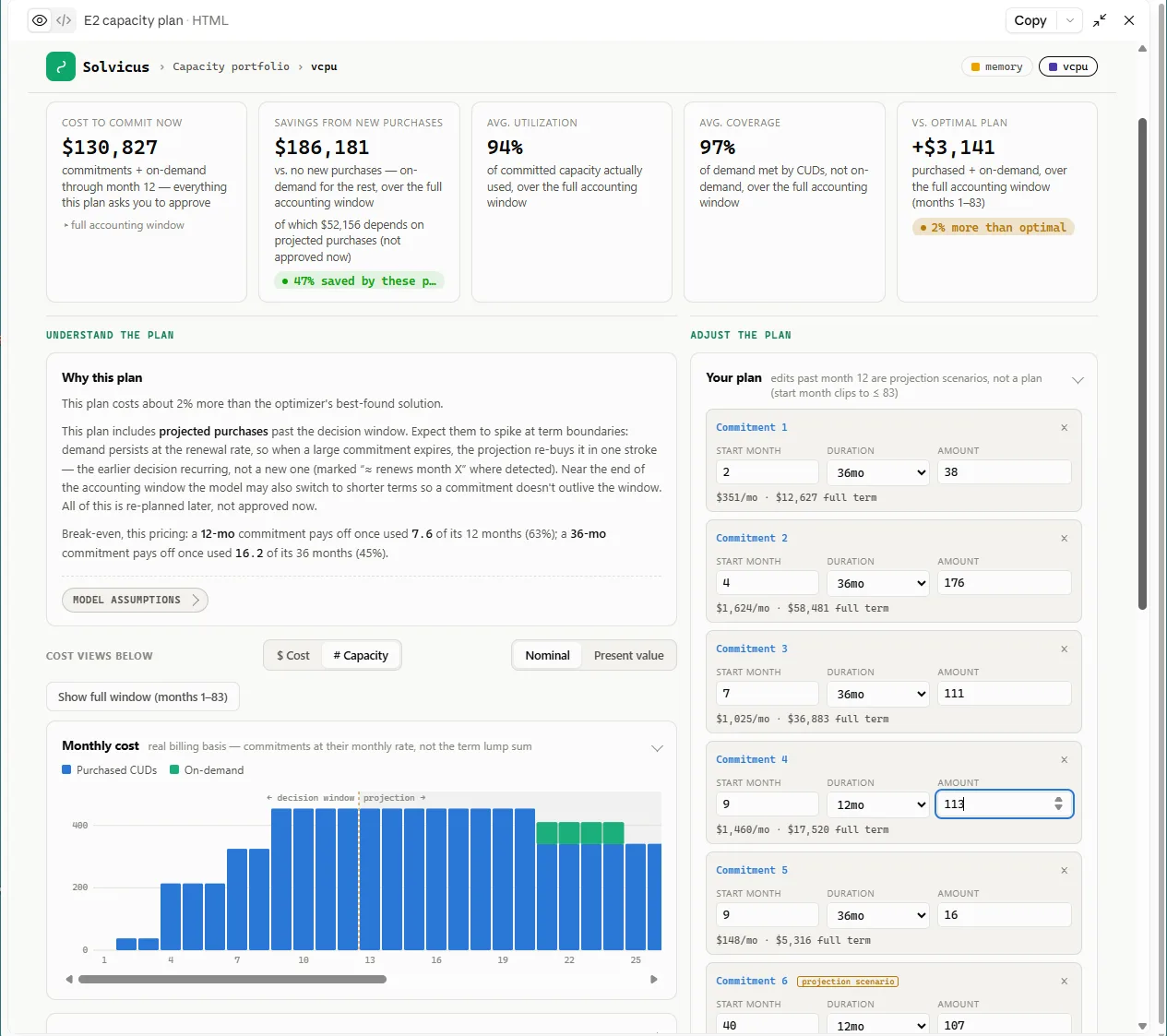
Solvicus turns your situation into a precise optimization problem and solves it. Each resource — vCPUs, RAM — becomes its own linear or mixed-integer program, built from your contracts' monthly demand net of the CUDs you already own. The model chooses the 1- and 3-year commitments to buy within your decision window that minimize total spend over a longer evaluation horizon, accounting for demand tapering as contracts lapse and renew. Because it's a mixed-integer program, the answer is provably cost-optimal for your inputs — not a heuristic or a best guess. See it end to end in the worked example.
You see it, change it, and stay in control
An optimal number is only useful if you trust it. Every Solvicus recommendation comes with an interactive dashboard: coverage, utilization, demand, and cost charts show exactly why each commitment is recommended, and you can override any purchase, run what-if scenarios, and stress-test the plan against different demand. And Solvicus never touches your Google Cloud console — it recommends and evaluates, but you make the purchases yourself. No billing write-access, no automation acting behind your back.
A FinOps MCP server for GCP CUDs
Solvicus runs as a Model Context Protocol (MCP) server, so you drive CUD optimization straight from the AI assistant you already use — Claude, ChatGPT, or Antigravity. Ask for a commitment plan in plain language; your assistant gathers the inputs and calls Solvicus, which returns the cost-optimal CUD purchases with the coverage, utilization, and break-even behind them. Unlike read-only FinOps MCP tools that only query your bill, Solvicus actually solves the commitment-optimization problem — and still never touches your console. More detail on the FinOps MCP server page.
How this compares to other CUD tools
Almost every other committed use discount tool sizes commitments from your usage history and then hedges what it can't predict. That's the right approach for unpredictable workloads and the wrong one when you already know your demand. See how GCP CUD tools compare — including head-to-head pages on Google's built-in recommender and ProsperOps.
Try it
Get a quick estimate with the CUD calculator, read the details of the GCP CUD optimization solver, or run your own numbers from your AI assistant with a free account.